I’m Shaun Johnston, the creator of Project Halley, and I’m delighted to announce the launch of this new website. Project Halley is built around a long-term idea: the journey toward 2061, the year Halley’s Comet returns. More than just a website, it is a space for curiosity, learning, and exploration. A place to share ideas, ask questions, and engage with astronomy, science, physics, and space in a way that feels accessible, thoughtful, and genuine.
How did we get here?
While our parents and teachers share all their knowledge about the world around us, I remember few discussions about astronomy as a child. I’m sure it was introduced to me along the way, but astronomy has always felt personal, as though it was something I discovered on my own.
Of course, astronomy and the universe are anything but personal. They are the one thing that humanity is forced to share without prejudice, and it cares little for our planetary squabbles. Even so, it always felt like something deeply my own; a passion that nobody else contemplated as much as I did. I never studied it in academia or worked in the sciences, so my relationship with astronomy developed naturally, independently, and sometimes a little lonely.
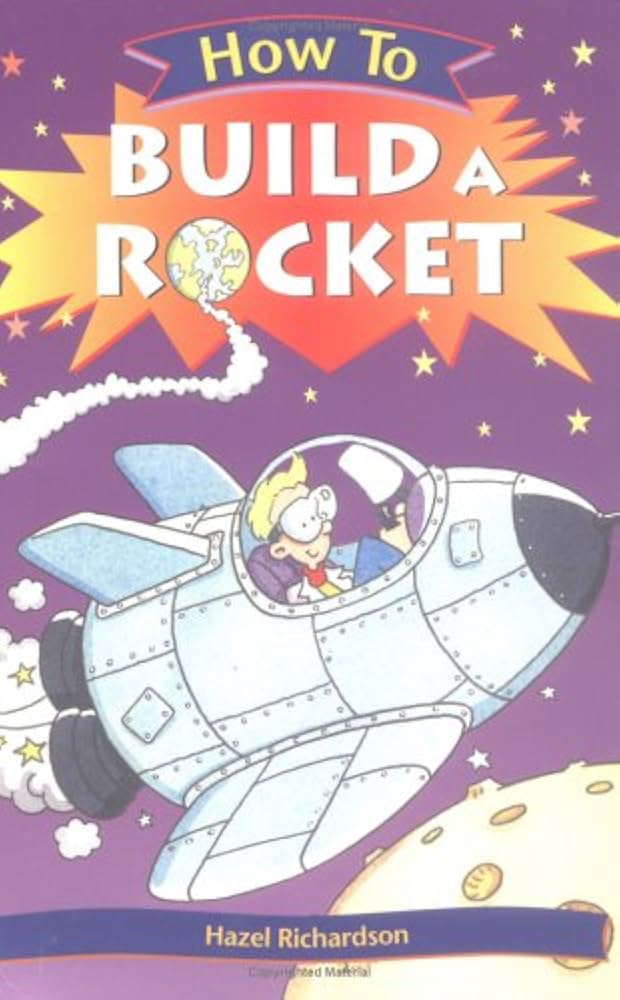
There are two books that I consider to be the foundations for my astronomy interest, both of which have remained with me since childhood. The first was gifted to me at a young age by a distant family member who worked in the industry – it is ‘How to Build a Rocket’ by Hazel Richardson (you can find it here). Designed for children (although I would argue adults too!), this book gave me my first insight into space travel, building rockets, and how to live on the moon. The ‘How To’ was truly an informative and exciting series that sparked my curiosity of science.
The other is the ‘Atlas of the Universe’ by Sir Patrick Moore. I’m not sure how I came to acquire this book. It was certainly not a children’s book, yet it fascinated me from the moment I found it. I often found myself gazing endlessly at its beautiful astrophotography while trying to make sense of the astronomical figures and complicated equations scattered across its pages. I still have my original copy, though it is battered, full of scribbles, and missing the first ten pages. I recently purchased a fresh copy to add to my collection.
To me, Atlas of the Universe was more than just a science book. In the late 1990s, the world already felt vast enough as a child, but this atlas offered a different kind of escape. It had the wonder of science fiction, except it was real. It introduced me to the Solar System, the Cassini-Huygens missions to Saturn and Titan, and to the idea that the shiny dots above us were not just lights in the sky, but places with stories, structure, and meaning. This book is truly a guide for the practical astronomer, and although I’ve never practised astronomy myself, it makes me feel like an astronomer at heart.
The allure of the cosmos has stayed with me for as long as I can remember. From staring up at the night sky to becoming emotionally invested in the wonders depicted in books, documentaries, and films, I’ve spent years listening to lectures, following podcasts, and taking courses that helped deepen that fascination. Popular scientists like Brian Cox have filled many of my evenings, and Carl Sagan’s Pale Blue Dot speech has yet failed to bring a tear to my eye. That desire to be part of the cosmic story I once read about as a child lingers, growing into a relentless pursuit.
We all have our own relationship with the cosmos. Since time immemorial, humans have gazed upwards, captivated by the celestial dance of the stars. Across cultures and epochs, we have woven our own stories into the night sky, drawing from it myths, meaning, guidance, and wonder. Human curiosity has always been boundless, as we seek to unravel the mysteries of the universe and find our place within the vast expanse that lies above us.
Project Halley is my response to that curiosity. It is a place to learn, explore, and share ideas about astronomy, physics, and space in an open and honest way. At its heart, this project is about looking forward to 2061 – the next return of Halley’s Comet – and using that long horizon as inspiration to keep learning, writing, and engaging with the universe. I’m not writing as an academic or an expert, but as someone with a lasting passion for these subjects and a genuine desire to understand them more deeply. So welcome to Project Halley. I hope this becomes a place where curiosity is encouraged, big questions are welcomed, and the wonder of the universe feels a little closer.
Whether you’re just beginning or have been looking up for years, I hope you’ll join me on the journey to Halley’s Comet’s return. Not simply for the moment it arrives, but for everything we can learn, create, and discover between now and then.